
Cataract Surgery
A short, common procedure in which the clouded natural lens is removed and replaced with an artificial intraocular lens to restore vision.
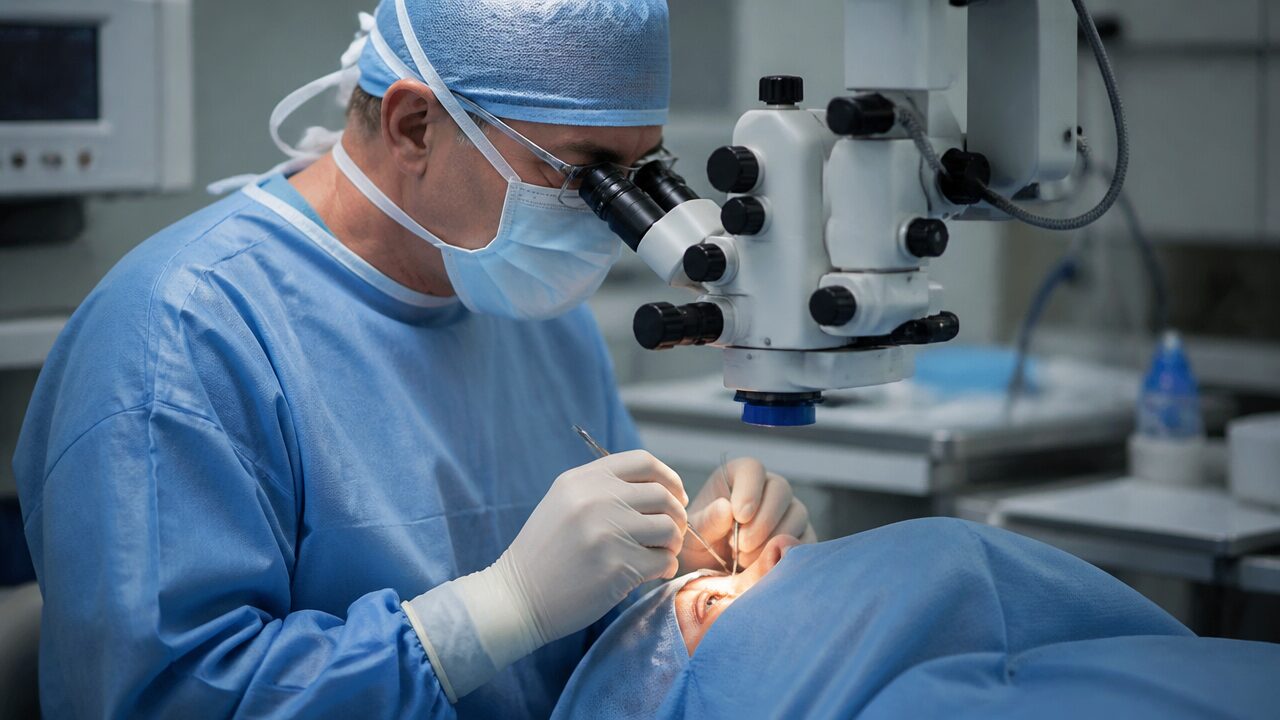
Cataract surgery is a surgical procedure performed to treat cataract, a condition that causes vision loss as the eye's lens loses its transparency. During cataract surgery, the clouded natural lens is removed and replaced with an artificial intraocular lens (IOL). This restores vision to a large degree. The operation is usually performed under drop anaesthesia and generally takes 10–20 minutes. Today it is one of the most commonly performed and safe surgical procedures. Cataract surgery should not be postponed; the longer the lens stays in the eye the harder it becomes, and the surgery can become more difficult.
Before Cataract Surgery
Before the operation we invite you to our clinic one hour beforehand for your paperwork, consent procedures and dilation of the pupil.
Afterwards one of our clinic staff will take you down to the day-surgery floor. Here your blood pressure is measured, an intravenous line is opened, and you are dressed in the surgical clothing.
Finally, accompanied by a nurse and staff, you are brought to the operating-room waiting hall, and after waiting there for a while you are taken into the eye operating room.
How Is Cataract Surgery Performed? What Will You Experience in the Operating Room?
Do not panic, do not worry, relax, breathe deeply, and imagine yourself in the place where you feel best. It will be over quickly anyway, so do not be anxious.
Your eye is numbed with drops so that you do not feel pain during the operation. But you will feel what we are doing, and at times a pressure-related tension may build up in your eye.
Your eye is wiped with antiseptic (Batticon) and covered with a sterile drape so that no germs reach your eye from anywhere.
We ask you not to move your body, head, hands or eyes, because the eye is a very small organ and every movement makes our work harder. Please take your most comfortable position before the operation, and share with us if you have any problem.
Phacoemulsification: a small incision is made in the eye and, using a special device, the clouded lens is broken up with ultrasonic waves and removed.
Placement of the artificial lens: an artificial intraocular lens is placed where the natural lens was removed. This lens stays permanently in the eye and provides the patient's vision.
When the operation is finished the drape is lifted, and you are transferred from the operating table to a wheelchair and taken back up to the day-surgery floor.
After Cataract Surgery
If you wish, you can rest for a while. You can then get dressed and go home.
For 3 days do not bend forward, do not lie on the operated eye, and do not rub your eye forcefully. About 5–6 hours after the operation you may open your eye and instil your drops every 2 hours.
Recovery After Surgery
For a few days after surgery there may be mild discomfort and blurred vision in the eye. Most patients can return to their normal activities within a few days, and the recovery process is usually completed within 1–2 weeks. The eye drops prescribed by the eye doctor are used, and follow-up examinations are carried out regularly.
Artificial Lens Options
The lens to be used in cataract surgery is determined according to the patient's needs. The quality of the chosen lens is just as important as completing the surgery well. Monofocal lens (single focus): single-focus, it corrects only one distance (usually far vision), and reading glasses are needed. Monofocal Plus lens (dual focus): provides far and intermediate distance (70–100 cm) vision, with glasses needed for near. EDOF lens (smart lens, extended focus): provides far and intermediate vision, and in some cases glasses may still be needed for near. Trifocal lens (smart lens, three foci): corrects near, intermediate and far vision at the same time. Toric lens: used to correct astigmatism, a toric version of all of the above lenses is available, and it greatly improves the quality of vision after surgery.
In summary, cataract surgery is a safe and effective treatment that largely corrects age-related vision loss and other visual impairments. It aims for a good visual outcome, and patients can usually return to their normal lives in a short time.
This page is for general information and does not replace a personal examination. The right approach is decided together after an eye examination.
Frequently asked questions
Is cataract surgery safe if I have retinal disease?
Safety is high, but a comprehensive preoperative retinal/macular assessment is essential. If needed, cataract and vitreoretinal procedures can be combined by retina specialists.
What intraocular lens (IOL) options do you offer?
We offer monofocal, toric and select premium IOLs. Multifocal lenses are often unsuitable for macular disease, so IOL choice is individualized based on retinal status and visual goals.